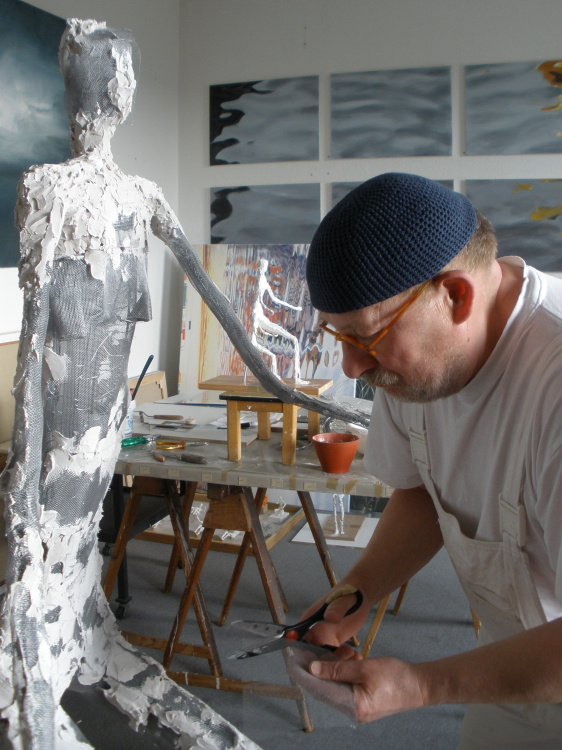
Vita
Born in Stintenburger Hütte (Zarrentin am Schaalsee) to Bessarabian refugees, Alfred Heth lost his father at the age of three. His mother moved with the children to Wismar, where he completed his secondary education. During this time, he also attended painting classes at the Wismar Music School.
In 1967, he began studying art education and history at the University of Leipzig, simultaneously attending evening classes at the Leipzig Academy of Visual Arts. After successfully completing his studies in 1971, he worked as a teacher in Güstrow. In 1976, he decided to work as a freelance artist in Wismar and became a full member of the Association of Visual Artists of the GDR in 1979.
Work and Reception
Since the early 1980s, Alfred Heth's work has been characterized by its distinctive style and content that defies easy categorization. This aroused political suspicion in the GDR, as his work did not conform to the expected socialist realism. His social withdrawal gave him the time and peace to mature as an artist. After the fall of the Berlin Wall, he was able to present works under changed political conditions that appeared unique, independent, and almost free from artistic movements, stylistic trends, and influences.
His works are manifestations of his engagement with diverse ways of life. His scientific and physical mind masterfully commands the formal aspects of the creative process. While his paintings, in their materiality, are always imprints of individual existence and signs of human beings, they are simultaneously signs of their transience.
Heth's aesthetic utilizes all forms and materials of our world to question them in new contexts, explore their nature, and reveal fragmentary glimpses of a fascinating self-awareness. His favorite subject was consistently the human figure, and he experimented with various materials in both representational and abstract forms.
Legacy
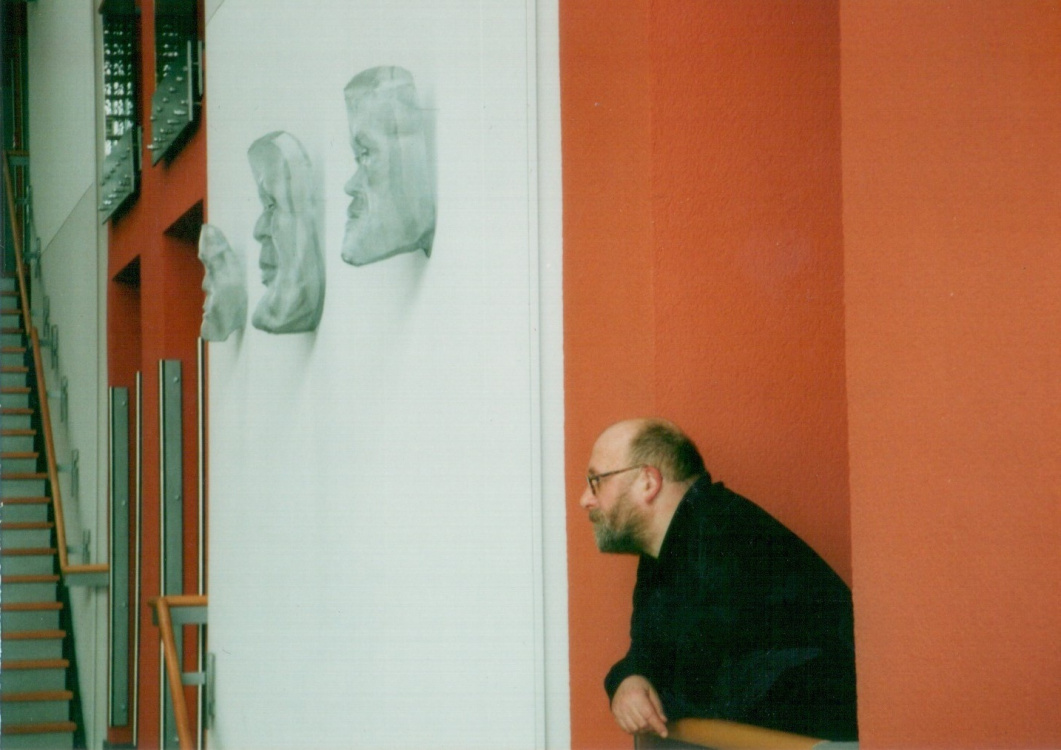
His work garnered particular attention in the late 1990s for his sculptural pieces. The themes of his origins as a refugee child with a lost homeland are reflected in the titles of his series: Family Tree, Memory of a Clan, Clan, Pompeii, and Atlantis. His work is decidedly oriented toward the human figure, systematically examining structures of physicality and exploring liminal situations between life and death.
Alfred Heth died on December 7, 2013, in Wismar, leaving behind a rich artistic legacy that continues to exert an influence and inspire. His works are held in numerous public collections and spaces throughout Germany, particularly in Mecklenburg-Western Pomerania.